


At some point you've probably thought about learning Spanish. Maybe you travel to places where it's spoken. Maybe you live somewhere it's everywhere and you want to actually understand what people around you are saying. Maybe you work with Spanish-speaking clients or colleagues. Maybe you just want to, which is a completely valid reason and doesn't need a productivity justification.
Whatever brought you here, the question isn't really "is Spanish valuable." Spanish is the second most spoken language in the world and the most commonly spoken language in the US after English — you probably already know it's useful. The question is whether it's worth your time, what it's actually going to cost you, and whether you'll actually get anywhere with it as an adult.
Those are the questions worth answering.
Why do you want to learn Spanish?
The single biggest predictor of whether an adult language learner succeeds is not aptitude, not the method they use, and not how much money they spend on apps. It's motivation — specifically whether they have a concrete, personal reason to keep going when it gets hard. And it does get hard.
Before we get into the how, it's worth being honest with yourself about the why:
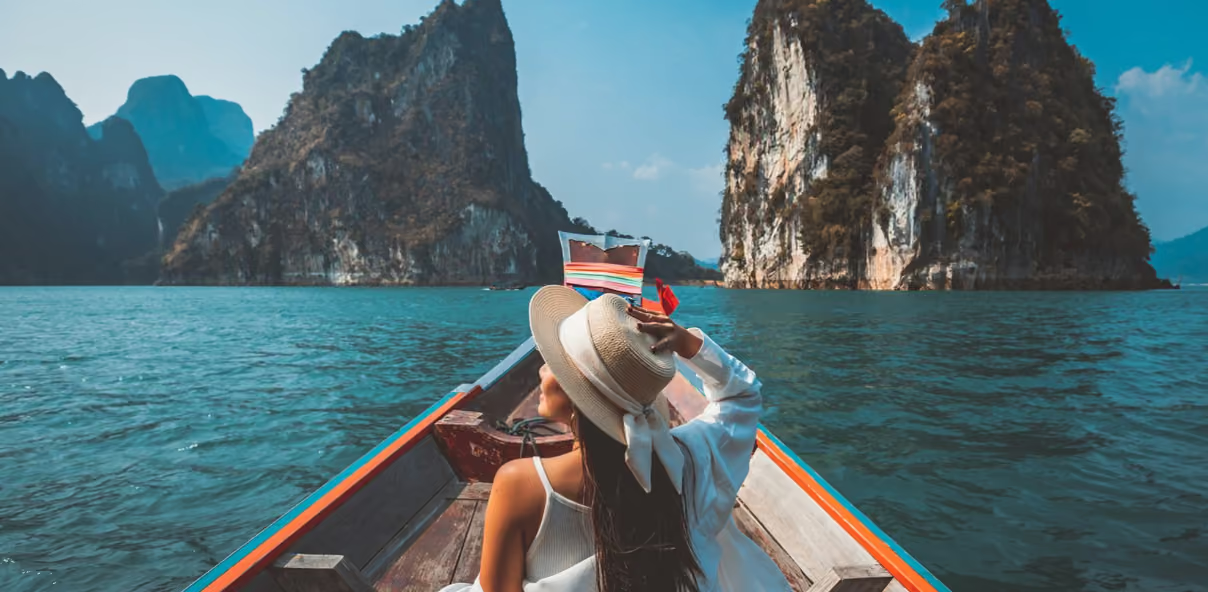
Because you want to travel the world.
If you go to Mexico, Latin America, or Spain regularly -- or want to take your first international trip soon -- Spanish can transform the experience. Not just in the practical sense of being able to order food or ask for directions, but in the deeper sense: talking with locals, understanding what’s happening around you, and getting something out of the places you visit that goes beyond the "in translation" version most visitors will pull off of the English explainer cards. The whole trip is less filtered because you're not getting someone else's interpretation of what's actually being said, you're creating your own.
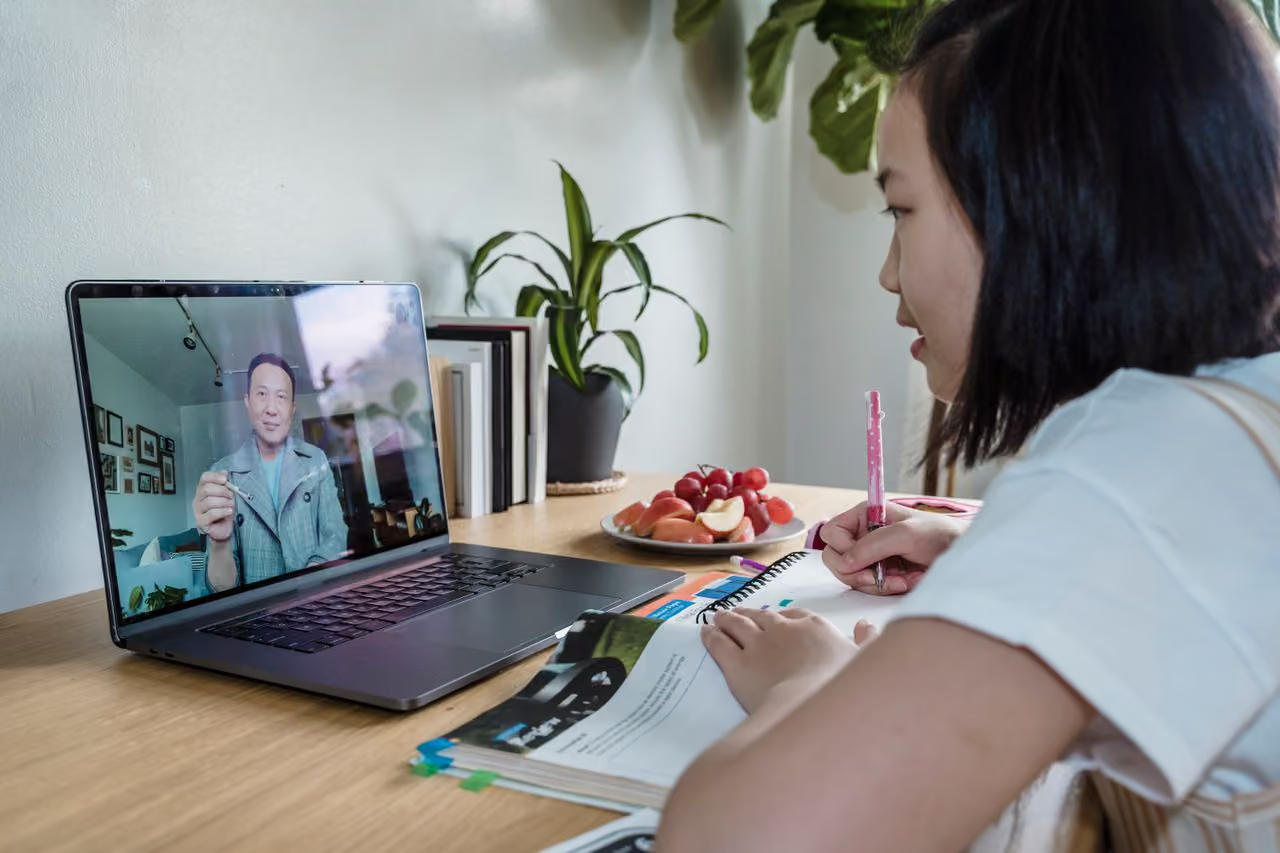
Because it will give you a leg up at work.
In many industries -- healthcare, education, social work, law, government, hospitality -- Spanish is more than a nice extra; it can be a real professional advantage. In some roles it comes with a direct pay bump. In others, it simply makes you more effective, more versatile, and more hireable. How much it matters depends on your field and your local job market, but in the right context it can meaningfully change your opportunities.
Because it will let you be more involved in your community.
Sometimes learning Spanish isn’t about travel or career advancement at all. It’s about belonging. It’s about understanding the conversations happening around you, being able to greet people in their own language, and participating more fully in the community you already live in. If Spanish is part of the fabric of your town, workplace, or neighborhood, learning it can make that fabric feel more accessible -- and give you endless chances to practice.
Because learning a language is a great brain workout.
Not every reason to learn Spanish has to be practical or cultural. Sometimes the reason is simply that it’s good for you. Language learning pushes your brain to build new pathways: holding vocabulary in memory, parsing grammar in real time, and making connections across contexts. It’s difficult, yes—but that difficulty is part of what makes it such powerful cognitive exercise. More on the science below.
Because you want to enjoy Spanish culture/media more easily.
Culture is one of the best reasons to learn Spanish. Maybe it started with Bad Bunny, a Spanish-language Netflix binge, or realizing how much gets flattened in translation when reading Gabriel García Márquez or listening to Rosalía. Spanish opens the door to an enormous world of music, film, literature, and television—and wanting access to that world is reason enough.
Just because you want to.
This is valid. You don't need a productivity justification for learning something. But you do need enough genuine interest to sustain the habit through the slow middle months, so being honest about whether you're actually curious or just think you should be is worth a moment.
"You can't learn a language as an adult" is a Myth
This one is genuinely worth addressing before anything else because it stops a lot of people before they start.
The idea that adults can't learn languages — or can only learn them imperfectly, with an accent, never really fluently — is partially true and mostly misunderstood. Adults do not acquire language the same way children do. Children are exposed to language constantly, have no alternative communication system to fall back on, and have brains in an especially high-plasticity developmental window. That produces native-like fluency and native-like pronunciation with enough time.
Adults learn differently, not worse. Researchers at MIT confirmed it. Adult learners reach conversational fluency faster than children when using structured methods, because adults have the cognitive tools to understand grammar explicitly, build vocabulary strategically, and apply learning techniques that children can't use. What adults sacrifice is the native-like accent ceiling — most adults who learn a second language after puberty will have a detectable accent even at high proficiency. That matters much less than it sounds like it does.
The practical ceiling for an adult learner of Spanish: fluent, professional-level Spanish is achievable and is achieved regularly by people who start as adults. What's harder to achieve is being mistaken for a native speaker. Most people don't need that.
The honest case against — what it actually costs you
Learning Spanish as an adult is worth it. It is also genuinely time-intensive, and being honest about that upfront is more useful than glossing over it.
The US Foreign Service Institute — which trains diplomats in foreign languages for a living — classifies Spanish as a Category I language, the easiest category for English speakers. Their estimate for professional working proficiency is 600 to 750 hours of study. At 30 minutes a day that's three to four years. At an hour a day with good methods it's closer to 18 months.
Conversational fluency for travel and daily life comes faster. Most people reach basic conversation in three to six months of consistent study. But "I can handle myself at a restaurant and ask for directions" is different from "I can negotiate a business contract or follow a fast-paced conversation between native speakers."
The three genuine challenges:
Consistency is the whole game. Language learning is compounding — each hour builds on the last. Irregular bursts of intensive study followed by weeks of nothing produces almost no progress. Thirty minutes every day is worth more than five hours once a week. If you're not willing to make it a daily habit, the realistic outcome is moderate plateau, not fluency.
Speaking practice is non-optional. Apps and textbooks build vocabulary and grammatical intuition but they do not make you comfortable speaking. Real fluency requires real conversation — a tutor, a language exchange partner, or immersion. Many people study for months and can read Spanish adequately but panic when a native speaker actually talks to them.
The intermediate plateau is real and frustrating. Getting from zero to basic conversation happens relatively fast. Getting from basic conversation to genuine fluency is a long, slow grind where progress feels invisible. Most people quit here. Getting through the intermediate plateau requires either a compelling reason to keep going or a very ingrained habit.
How to Actually Learn Spanish as an Adult (Not Just Memorize a Few Phrases)
The best method is the one you'll actually maintain. That said, the research on adult language acquisition is fairly consistent on what works and what doesn't.
What works:
- Structured input at your level. Reading and listening to Spanish you can mostly understand with some effort. This is the most efficient way to build vocabulary and grammatical intuition simultaneously. It's also more enjoyable than drilling flashcards.
- Spaced repetition vocabulary. Apps like Anki or the vocabulary system in Babbel present words at the optimal interval for long-term retention. This dramatically reduces the time needed to build a working vocabulary.
- Speaking early and often. Not when you're "ready," which never comes. Speaking with a tutor or language partner from the beginning, even badly, accelerates all the other learning because it forces active recall rather than passive recognition.
- Consistent daily practice over intensive weekend sessions. The research on this is unambiguous. Frequency matters more than duration.
What apps are good for:
Language apps are excellent for vocabulary building, grammatical pattern exposure, and the kind of consistent daily habit that keeps the language active in your brain. They are not sufficient on their own for conversational fluency. Think of an app as the foundation — you still need to build the house.
The most effective apps for Spanish specifically -- Babbel, Duolingo, Pimsleur, and Rosetta Stone -- each take a meaningfully different approach. If you aren't sure which one is right for you, we tried out and reviewed the most popular language apps here to give you a full comparison.
What it Actually Costs (and Free Routes People Don't Talk About Enough)
This is where a lot of language learning content undersells the options. There's a spectrum from free to expensive and the expensive end is not necessarily better:
Free Resources
- Spanish dubs of shows you already watch on Netflix, Disney+, and other streaming platforms. Switching the audio track on something you've seen before in English is super effective immersion
- YouTube. Channels like Dreaming Spanish (comprehensible input method) have thousands of hours of free content at every level
- Your local library. Most libraries have Mango Languages free with a library card, plus physical books, bilingual readers, and sometimes conversation groups
- Duolingo's free tier. Limited but functional for building a daily habit
- Language exchange apps (Tandem, HelloTalk). Connect with native Spanish speakers who want to learn English, practice together for free
- Social media. Follow accounts in Spanish on whatever platform you use. A little exposure to your target language in funny, relatable tidbits adds up faster than you would think.
- People in your life. If you have coworkers, neighbors, or family members who speak Spanish, practicing with real people you already know is both free and extremely effective
Affordable Resources($10–30/month)
- Babbel, Duolingo Plus, Pimsleur, Rosetta Stone — structured apps with varying approaches. We're putting together a full comparison of these based on actual adult beginner experience.
- Community college classes — often $100–200 for a semester course with an actual teacher, structured curriculum, and accountability
Bigger Investments
- Private tutoring (iTalki, Preply) — $15–50/hour depending on tutor. One or two sessions a week accelerates progress dramatically, especially for speaking. Not necessary from day one but worth adding once you have basics
- Immersion programs or extended travel — expensive but genuinely the fastest route to fluency if you have the ability to do it
The honest take: the free and low-cost routes are genuinely effective. The research does not support spending more money to learn faster — it supports practicing more consistently. An expensive app you use every day beats a free app you use twice a week. A language exchange partner you meet with weekly beats a tutor you cancel on. The method matters less than the habit.
Should you learn Spanish specifically, or another language?
If you're deciding between languages rather than having already chosen Spanish, here's the honest comparison for US adults:
🇪🇸 Spanish is the highest-utility choice for most people — most widely spoken in the US after English, most countries to visit, most career applications, easiest for English speakers to learn.
🇨🇳 Mandarin has significant career utility in specific industries (tech, finance, trade) but is dramatically harder — FSI estimates 2,200 hours versus 600 for Spanish. The ROI is higher in specific contexts and lower overall.
🇫🇷 French is the second-easiest Romance language after Spanish and has strong professional utility in international business, diplomacy, and parts of Africa. A strong choice if your career or travel interests point that direction.
🇵🇹 Portuguese is often underestimated — Brazil is the largest economy in Latin America, and if you already speak Spanish, Portuguese comprehension comes fairly quickly.
For most US adults asking the question from scratch: Spanish first, everything else after.
Where to Start with Learning Spanish
The best starting point is a structured app with daily habit built in — not because apps alone will get you to fluency, but because they lower the friction enough to actually start and stick to a daily practice. Once you have a habit and basic vocabulary, adding a tutor or conversation partner accelerates everything.
We've tried the major Spanish learning apps as adult beginners and written up the honest comparison — what each one is good for, what each one misses, and which combination actually works.
So is it worth it?
If you have a real reason — even one as simple as "I've always wanted to" — and you're willing to build a consistent daily practice, yes. Spanish is achievable as an adult, it's more accessible than most people think, and the payoff compounds over time in ways that are hard to anticipate before you've actually done it.
If you're not sure you have the motivation to sustain it through the slow middle, the honest thing to do is start free — a library card and a Netflix account with Spanish audio — and find out whether the curiosity is real before spending anything. You'll know within a month.