



The summer before college has a particular quality to it. You've gotten in, you've committed, the hard part is theoretically done — and now you have eight weeks of wide-open time that feel simultaneously infinite and like they're already running out.
Most advice about this period falls into two categories: a logistics checklist (buy these things, pack this way) or vague emotional reassurance (you're going to love it, everyone feels nervous). Both are fine. Neither is quite what you actually need.
What you actually need is somewhere between the two — the practical things that make freshman year genuinely easier, the emotional preparation that nobody talks about directly, and the honest acknowledgment that these eight weeks are a distinct and unrepeatable moment worth being deliberate about.
Here's how to spend them.
1. Learn to do your own laundry. Like for real.

Not "watch someone else do it" or "know that you put detergent in." Actually do it yourself, start to finish, including figuring out what the settings mean, what gets washed cold versus warm, what cannot go in the dryer, and how to get a stain out before it sets.
This sounds absurdly basic but it's worth brushing up on. There's something different about doing laundry at home vs. fighting for your life in the laundry room for your floor, or (even worse) the whole building. And trust me when I say that a dorm laundry room at 9pm during the first week of school is not the place to figure out that your favorite sweater shrinks in the dryer.
2. Cook five actual meals.
.gif)
Not five elaborate recipes. Five things you can make from ingredients that exist in a normal kitchen — pasta, scrambled eggs, a stir fry, a simple soup, rice and whatever. The goal is to have a small rotation of things you actually know how to make when you eventually have access to a kitchen, whether you lucked out and got a kitchen in your freshman dorm, have a kitchenette the whole floor shares, or you're tucking those skills away for sophomore year or when you're cooking for yourself on breaks.
Even if you're on a meal plan for all four years, knowing how to feed yourself is one of the foundational adulting skills. The summer before college is a good time to practice with someone who has a little more experience under their belt.
3. Practice being alone -- and being okay with it
.gif)
This one nobody tells you. College involves a lot of time that is technically alone — walking to class, eating in the dining hall by yourself before you've made friends, sitting in your room while your roommate is elsewhere, spending a weekend night in when everyone seems to be out.
If you've never spent time alone and been genuinely comfortable with it, practice now. Go to a restaurant or movie by yourself. Spend a full day without making plans. Get acquainted with your own company, because in the first few weeks of college you'll have more of it than you expect and how you handle it sets the tone for your whole first semester.
4. Have the money conversation with your parents
.gif)
Not just "here's how much spending money you have per month." The full version: what happens if you have a financial emergency, who covers what if something unexpected happens with your health or your laptop or your car if you have one, what the expectation is around summer jobs and contributions, whether your parents expect to know how you're spending your money, and what financial independence looks like in their minds versus yours.
These conversations are awkward before they're necessary and catastrophic when they happen during a crisis. Summer is the right time.
5. Reset your sleep schedule
.gif)
Dorm life runs late. Even if you're personally committed to sleeping well, your roommate, your floor, and your building have other ideas — and the social events that matter for making friends in the first few weeks tend to happen at 10pm and later.
Start shifting your sleep later now, gradually, so your body isn't completely wrecked during the first month. More importantly: figure out your actual sleep needs. Some people function fine on six hours and some people are genuinely impaired without eight. Knowing which you are before you're managing it in a shared room is useful information.
6. Read something purely for pleasure
.gif)
Starting college means reading on demand — syllabi, assignments, required texts. The summer before is one of your last long stretches of reading whatever you actually want, at your own pace, with no deadline.
Use it. Read the book that's been on your list. Reread something you loved at 14. Read something completely frivolous. While class is in session, you'll probably find yourself so busy with classes and clubs and reading assignments that you don't really have the time or energy to pick up something that's just for you. So knock a couple books off your TBR while you've got the chance!
7. Get your finances set up
.gif)
Before you leave: make sure you have a bank account you can manage independently (not just a custodial account your parents control), a debit card that works, and a basic sense of your monthly budget. If you don't have a credit card yet, the summer before college is a good time to get a starter card and begin building credit — you won't qualify for much but you don't need much. A secured card or a student card is fine.
Know how to dispute a charge, transfer money, set up direct deposit, and check your balance. These are five-minute things that an alarming number of incoming freshmen genuinely don't know how to do.
8. Sort out your health care before you leave
.gif)
Get a physical. See a dentist. Refill any prescriptions to last through the first semester. If you see a therapist or psychiatrist, either find someone at or near your school before you arrive or get a plan for continuity of care. This last one especially — the wait list for campus mental health services is genuinely long at most schools, and starting at the beginning of the semester is dramatically easier than starting mid-semester in crisis.
If you're on your parents' insurance, understand what it covers at school and what it doesn't. Know the campus health center hours and what it costs. This is the kind of thing that feels unnecessary to research until you need it at midnight.
9. Contact your roommate about the practical stuff
.gif)
Reach out. Be friendly. Coordinate on the big shared items: mini fridge, microwave, shower caddy, TV if either of you plans to bring one. Establish basic expectations around sleep schedules, guests, and shared space in the most surface-level way — enough to not be surprised on day one.
Don't try to build a deep friendship over text before you've met. Don't overshare. Don't undershare to the point of being mysterious. Be normal. Your roommate doesn't have to become your best friend — they just have to be someone you can share 200 square feet with without it becoming a problem. Keep expectations proportionate.
10. Shop for your dorm, but not too early
.gif)
There's a version of summer-before-college that involves buying everything in June and then realizing in August that your dorm has built-in furniture that makes half of it redundant. Wait until you have your actual housing assignment and have talked to your roommate before buying anything that depends on layout, size, or what the other person is bringing.
The things worth buying early: twin XL sheets (confirm the size), a good mattress topper, a shower caddy, shower flip flops, a surge protector. Everything else can wait until you know what you're working with.
For the full list of what actually matters versus what's a waste of money, we put together a complete dorm room shopping list — room by room, with what to skip.
11. Say proper goodbyes, not performative ones
.gif)
The friendships and relationships from home are going to change. Some will survive college intact and some won't, and you mostly can't predict which is which in advance. What you can do is say what you actually want to say to the people who matter before you leave — not dramatically, just genuinely.
Have a real conversation with your parents about what this transition means. Tell your best friends you love them. Visit your grandparents if you have them. These feel obvious and are easy to skip in the logistics chaos of the last few weeks before move-in. Don't skip them.
What's less useful: trying to lock down the future of every relationship before you leave. Long-distance friendships and relationships work best when they're maintained naturally rather than anxiously. Agree to stay in touch, mean it, and then actually do it — rather than over-engineering it before you've even left.
12. Lower your expectations for the first two weeks
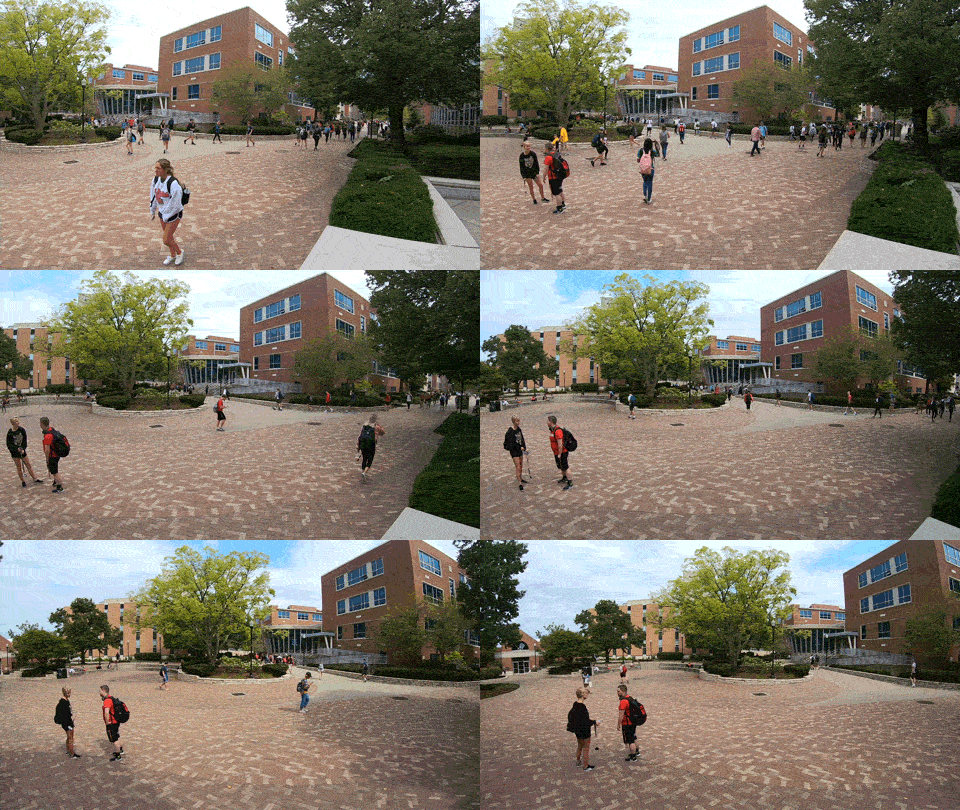
This is the most important one and gets said the least directly: the first two weeks of college are almost universally awkward, overstimulating, and more lonely than you expected. This is true for almost everyone, including the people who look like they're having the best time on Instagram.
You will probably have at least one night in those first two weeks where you sit in your room feeling like everyone else has figured it out and you haven't. That night is a completely normal part of the process, not evidence that you made a wrong choice or that you're different from everyone else. It might be a little rocky at first, but you'll survive freshman year -- and that includes the first few weeks.
The friends you make in the first two weeks probably won't be your closest friends by sophomore year. The person you are in the first two weeks probably won't be who you are by the end of freshman year. Give yourself and everyone around you the grace of being in an awkward transition and trust that it settles.
The summer before college is yours. It's a transition — between the life you had and the one you're building — and transitions are allowed to feel strange and significant and fast and slow at the same time.
The practical prep matters. So does the emotional prep. So does giving yourself permission to just be here, in this summer, without rushing toward what comes next or holding on too tightly to what's ending. it's a lot to pack into a few short weeks, but before you know it, you'll be navigating campus like a pro, have a go-to group of pals, and your previously blank slate of a dorm room will start to feel like home.
You're more ready than you think. And the parts you're not ready for, you'll figure out.