


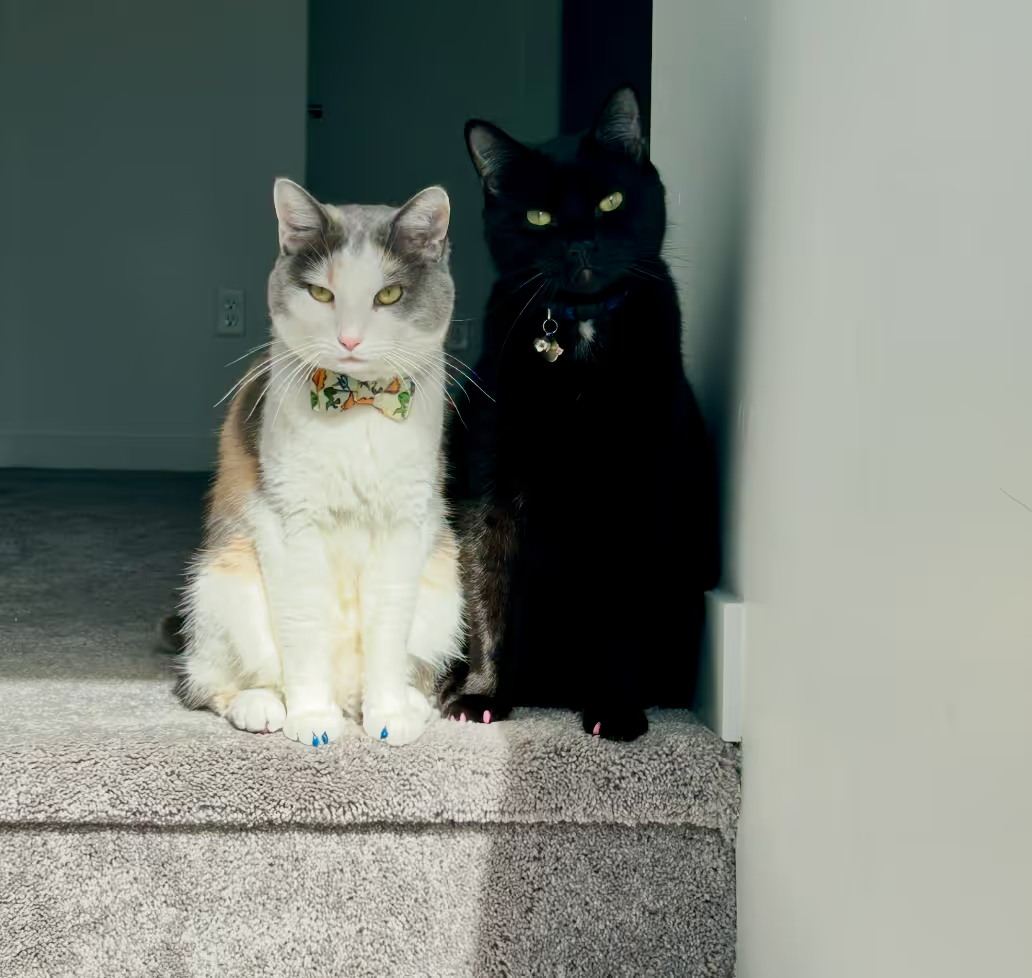
I have two cats. And I love them in a way that is completely disproportionate to what a reasonable person might consider appropriate for small animals who occasionally knock over my water glass and leave pipe cleaners in my shoes. They are, without qualification, part of my family. Full stop, end of story. They're with me.

And while I could talk about them for a looooong time, this isn't the digital equivalent of whipping out my wallet to show you photos of my kids. I say this because I think it's important context for what follows. We're here to talk about pet insurance, and I want you to know that I'm not looking at it as a financial exercise. I'm approaching it as someone who would absolutely put an emergency vet bill on a credit card without a second thought, someone who has thought carefully about whether there's a smarter way to handle that.
The relationship between people and their pets has shifted a lot in my lifetime. It's amazing to see how much more pets are treated as family members now compared to even twenty years ago, and a lot of that reflects real changes in how people are living. When homeownership feels increasingly out of reach and starting a human family feels further and further off for each generation, the animals you share your home with take on a different kind of role in your household.
They live in your space. They share quiet moments with you. They're there for you when you need them. And you are responsible for their wellbeing, completely, absolutely, and without backup. They can't do it themselves, so it's on you. That's no small thing.
Which is why the pet insurance question is worth taking seriously.
Is it always the right financial decision? No.
But when you're making a decision with stakes like the wellbeing of those fuzzy little friends who look to you to keep them safe, every option is worth considering, right? Leave no stone unturned.
But the math isn't as straightforward as pet insurance companies would have you believe, so we're taking a hard look at whether pet insurance is worth it or not. Is it a good value, or is it a scam dressed up to tug at your heartstrings? Let's find out.
What pet insurance actually covers
Most pet insurance policies cover "accidents and illnesses," which is probably what you as a pet owner are expecting them to cover. You're looking for a service to help with unexpected vet bills from injuries, infections, foreign body ingestion, cancer, orthopedic issues, and other conditions that arise without warning. And most of them do.
That being said, there's a major gap: most standard pet insurance policies do not cover things like:
- Pre-existing conditions. Anything diagnosed before the policy start date or during the waiting period
- Routine and preventive care. That's vaccines, annual exams, flea and tick prevention, etc (unless you add a wellness rider)
- Breeding costs
- Cosmetic procedures
- Dental illness (though dental accidents are often covered)
For routine care, you have the additional option of wellness plans, but those are an entirely different thing from pet insurance.
Wellness plans are more like a prepayment plan for expected costs than protection against unexpected ones. Sometimes they're available as an add-on through your pet insurance provider, but you can also find them as standalone products. Some veterinary offices even offer wellness plans of their own, but we'll get into whether or not those are worth the price in a sec.
The three main types of pet insurance: accident-only (cheapest, narrowest coverage that often skips the items above), accident and illness (the most common and the one that's probably most worth considering), and comprehensive (accident, illness, and wellness combined, which is both most expensive and most difficult to find).
Whether any of these services make sense to buy depends on your vet and your pet's routine care costs.
How pet insurance actually works
Most pet insurance operates on a reimbursement model, not a direct payment model. That means you pay the vet bill upfront, submit a claim, and get reimbursed for the covered portion after your deductible. Which means you still need to have the funds to cover the bill in the moment. Pet insurance doesn't remove that requirement, it's just a safety net to maybe give you some of your money back afterward.
The reimbursement structure works like this: you choose a deductible (typically $100–500 per year or per incident depending on the policy), a reimbursement percentage (usually 70%, 80%, or 90%), and an annual coverage limit ($5,000 to unlimited depending on the plan). After you hit your deductible, insurance covers your chosen percentage of covered costs up to the annual limit.
Example: your cat needs emergency surgery costing $4,000. With a $250 annual deductible, 90% reimbursement, and an unlimited annual limit, you pay $250 + $375 (10% of the remaining $3,750) = $625 out of pocket. Without insurance: $4,000.
The real math: premiums vs. claims
One of the big concerns about pet insurance is that most policyholders pay more in premiums over their pet's lifetime than they receive in claims. This is stastically likely to be true — and it's also true of car insurance, home insurance, and health insurance. Insurance is not really about savings. It's about risk management.
The question is not "will I get back more than I pay in?" The question is "can I absorb the cost of the bad scenario if it happens?"
For most pet owners, the answer is not easily.
A single orthopedic surgery for a dog can run $3,000–8,000.
Cancer treatment, depending on the type, can exceed $10,000.
An emergency hospitalization for a cat with urinary blockage — which is a common condition in male cats — typically runs $1,500–3,500.
These aren't extreme, uncommon, unlikely cases. They're the kinds of things that happen to ordinary pets with surprising frequency.
And while you may or may not hesitate to pay for the care your pet needs, thinking of a surprise $5,000 expense is... stressful. That's why we're trying to think of the best way to plan for these sorts of emergency scenarios (although hopefully you never need to deal with it).
How breed and age change the math significantly
Pet insurance is not one-size-fits-all, and the breed and age of your pet are the two variables that matter most.
By breed: Some breeds carry dramatically higher health risks than others, which insurers price accordingly. French Bulldogs, English Bulldogs, and Pugs are prone to brachycephalic syndrome and respiratory issues. Golden Retrievers have an elevated cancer risk — studies suggest up to 60% develop some form of cancer in their lifetime. German Shepherds are predisposed to hip dysplasia. Maine Coons and Ragdolls are prone to hypertrophic cardiomyopathy. Dachshunds commonly develop spinal issues. If your pet is a breed with known health predispositions, the expected value of insurance goes up considerably.
Mixed breed dogs and cats tend to be healthier on average than purebreds — genetic diversity generally reduces the likelihood of inherited conditions. If you have a healthy, mixed-breed young adult with no diagnosed conditions, the financial case for insurance is harder to make, though the peace of mind argument still stands.
By age: Enroll when your pet is young — under 2 ideally. Premiums are lower when pets are young and healthy. And conditions that develop after the policy starts are covered, while anything diagnosed before or during the waiting period is classified pre-existing and excluded going forward. An older pet with existing health issues will pay higher premiums for narrower coverage. This doesn't make insurance worthless for older pets — it means you need to read the exclusions carefully and calculate whether the covered conditions represent meaningful risk.
Waiting periods matter too: most policies have a 14-day waiting period for illness and 2 days for accidents. If your pet gets sick before the illness waiting period ends, that condition may be classified as pre-existing.
What to look for when comparing plans
Not all pet insurance policies are created equal, and the differences matter more than the premium price.
Annual vs. per-incident deductibles: An annual deductible resets once a year and applies to all claims. A per-incident deductible applies separately to each new condition. If your pet develops a chronic condition requiring ongoing treatment, an annual deductible is almost always better.
Coverage limits: Some policies have annual limits ($5,000, $10,000), others are unlimited. For peace of mind against truly catastrophic events — cancer, major surgery, complex ongoing treatment — unlimited annual coverage is worth the higher premium.
Reimbursement basis: The most overlooked variable. Some policies reimburse based on your actual vet bill. Others reimburse based on a "benefit schedule" — a predetermined amount per procedure that may be significantly lower than what your vet charges. Actual cost reimbursement is almost always the better deal.
What's excluded: Read this section carefully. Hereditary and congenital conditions are excluded by some policies — which matters enormously for breeds with known inherited conditions. Bilateral conditions are sometimes only covered on one side. Dental illness is frequently excluded. Behavioral issues and training costs are excluded by essentially everyone.
Waiting periods: Standard is 14 days for illness, 2 days for accidents. Some providers offer shorter waiting periods or waive them with a vet exam.
The payment flexibility problem + smarter ways to solve it
Okay, let's just put it out there: pet insurance is expensive. So for a lot of pet owners, the real appeal of pet insurance isn't financial efficiency. It's the ability to spread a large unexpected cost over time rather than facing it all at once in an already stressful moment.
That's a legitimate need. But it's also worth separating from the insurance question because there are several ways to get that payment flexibility that may be more cost-effective than paying premiums for coverage you might not fully use.
Vet wellness/care plans (which are payment plans, not true insurance)
Many vet practices offer in-house wellness or care plans — monthly payments that bundle preventive services and sometimes include a discount on other services. These can be convenient, but read them carefully.
Most wellness plans are not insurance. They don't protect you against a surprise $4,000 bill — they give you a small discount off it and a year of nail trims in exchange for your monthly payment. The bundled services often include things you wouldn't otherwise prioritize, which pads the perceived value without adding much actual financial protection. The savings on emergency and surgical services are typically in the 10–20% range — meaningful, but not transformative when a $6,000 surgery is on the table.
Wellness plans can make sense if the bundled services are ones you'd genuinely use and the payment spread helps your cash flow. Just understand what you're getting: a prepayment plan, not risk coverage.
Credit card financing your vet bill (the right way)
Using a credit card to cover an unexpected vet bill and pay it off over time is a legitimate strategy — if you use the right card and understand the terms.
A credit card with a true 0% intro APR. Cards like the Wells Fargo Active Cash, Citi Double Cash, or Chase Freedom Flex offer genuine 0% APR for 15–21 months on purchases, plus cashback. A $3,000 vet bill paid off over 15 months costs $200/month with no interest — and you get 1.5–2% cashback. The limitation: you need to have the card before the emergency, not during it.
CareCredit. Useful but read the fine print. CareCredit is a healthcare-specific card accepted at many vet practices, offering promotional "no interest if paid in full" windows of 6–18 months. The critical warning: this is deferred interest, not true 0% APR. Miss the deadline and you're charged all the interest that would have accrued from the original purchase date — often at 26–29% APR, applied retroactively to the full original balance.
Scratchpay. Vet-specific financing product available at participating practices. Offers true 0% APR for shorter windows or low-APR installment loans for longer terms. More transparent than CareCredit. Worth asking your vet if they accept it.
If you're looking for the right card to have on hand for exactly this kind of situation, we've broken down the best credit cards for young adults — the 0% intro APR category is worth paying particular attention to.
The "self-insurance" alternative
Okay, so why not cut out the middle man entirely? One of the strongest counterarguments for pet insurance is "self-insurance." Instead of paying monthly premiums, you put that money into a dedicated savings account and use it if an emergency arises.
At $50/month, you'd have $600 in year one and $3,000 after five years. If your pet makes it to five years without a major emergency, you now have a meaningful fund and you've paid nothing in premiums. And all the better if you put it into a high-yield savings account, which offers better interest rates than a regular savings account but still lets you access your money easily if needed. The risk with this plan is that you never know when an emergency will happen. If it's in year one, when your fund only has $600, the bill could be much more than what you have set aside.
Self-insurance is safest for people who can fund their account with a meaningful starting amount (at least $2,000–3,000), have healthy low-risk pets, and are disciplined enough not to touch it. The problem is that most people who intend to self-insure don't actually do it. The money doesn't get set aside, it gets spent on other monthly expenses.
If you're the kind of person who would actually stick to it, this is a legitimate alternative.
If you're not sure, that's a reason to consider the behavioral argument for insurance since it forces the commitment automatically.
Before you decide
If you're a new pet owner who hasn't thought through any of this yet, our first-time pet owner checklist covers the full landscape of what to prepare for — including the medical history and vet care section, which is the foundation for any insurance decision.
A few practical steps worth taking before buying a policy:
- Get your pet a vet exam first so their current health status is documented. This establishes a baseline and helps you understand what would and wouldn't be covered.
- Get quotes from at least three providers. Premiums for the same coverage can vary 30–50% between providers.
- Read the exclusions list before you buy. The premium is the advertisement. The exclusions are the contract.
The bottom line
Pets can be expensive. Pet insurance isn't cheap, but neither are surprise vet bills.
On average, you'll probably pay more in premiums than you receive in claims. But does that really matter, or does it miss the point? You're not buying pet insurance to make money, or even to save money, really. You're buying it so that when your sweet, ridiculous, irreplaceable animal needs help, the question isn't whether or not you can afford it. So that you don't have to figure out financing on the fly.
For breeds with known health risks, young pets being enrolled early, or anyone who couldn't comfortably absorb a couple thousand dollar emergency, the math tends to work in favor of getting them covered. For genuinely healthy low-risk pets with financially prepared owners, self-insurance or a good 0% APR card in your wallet is a legitimate alternative worth considering.
Either way: make the decision before you need it. The time to think through pet insurance is not in a vet waiting room at 11pm.