


Reading is back in style, and as someone who has had her nose stuck in a book for more of my life than not, I could not be happier about that. Ebooks, audiobooks, physical books, whatever you're reading, I can't wait to hear about it.
Personally, I've read 52 books a year for the last three years (woo!), which has been a big deal for me after spending several years without the free time to put up numbers like that. I dunno if it's impressive or not considering my bestie is currently at *checks notes* 57 books for this year already, but I'm telling you this so you know where I'm coming from. I love to read. And I 100% get the struggle of trying to finance the hobby.
If you're looking for ways to keep reading without going broke, Kindle Unlimited is definitely an option to consider.
Kindles are cute. You can get lots of fun accessories. They fit in a bag, are easy to travel with, integrate with Goodreads... and compared to shelling out $15+ for a physical copy of every book on your TBR, a service like Kindle Unlimited can be a very cost-effective option. And while Kindles do have their own aesthetic at this point, you don't actually need to buy a Kindle device to use Kindle Unlimited. The free Kindle app works on your phone, tablet, or laptop, so the subscription stands on its own without requiring an additional $100+ device.
We'll get into all the nitty-gritty of Kindle Unlimited's value prop below, but the short version is this: Kindle Unlimited is a genuinely good deal for a specific kind of reader, and a pretty mediocre deal for everyone else.
From here, the question is whether it's worth it for the type of reader you are.
What Kindle Unlimited actually is
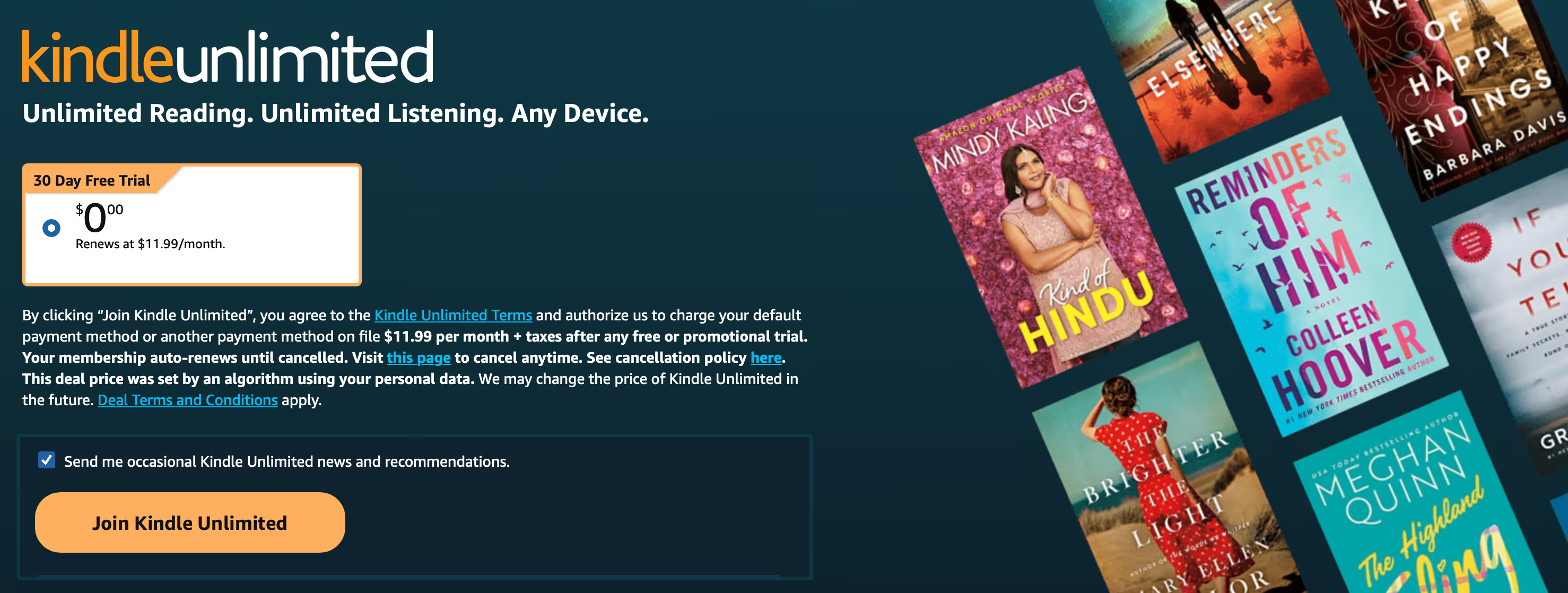
Kindle Unlimited is Amazon's ebook subscription service. It costs $11.99/month for access to over four million titles, plus a selection of audiobooks and magazines. You can have up to 20 titles borrowed at once, read them on any Kindle device or the free Kindle app, and return them when you're done to borrow more.
The pitch is simple: instead of paying $10–15 per ebook, you pay $11.99/month for unlimited reading. If you read more than one book a month, the math works, at least in theory.
The reality is a little bit more complicated, and it mostly has to do with what is (and isn't) in the catalog.
The catalog question: what's actually in Kindle Unlimited
Four million titles sounds enormous. And it is, until you start looking for the books you actually want to read.
Kindle Unlimited's catalog skews heavily toward self-published and indie titles, romance and romantasy, genre fiction, and older backlist titles. The Big Five publishers (Penguin Random House, HarperCollins, Simon & Schuster, Hachette, Macmillan) have largely kept their frontlist titles (new releases by established authors) out of Kindle Unlimited entirely. Which means if you're looking for the latest literary fiction, the buzzy debut everyone is talking about, or most prize-shortlisted titles, you probably will not find them in the KU catalog.
What you will find: an excellent selection of genre fiction. Romance, romantasy, cozy mysteries, thrillers, sci-fi, fantasy... it's all there in spades. So if those categories make a majority of your reading, there's legitimately a deep catalog of titles you'll probably love. Good deal.
And if you want to support smaller, indie writers, KU is also a good way to do that. We'll get into why below when we talk about how KU pays authors.
But on the flip side, if you're more interested in categories like literary fiction, nonfiction, prizewinners, or whatever happens to be the latest "it" book, you might find that the catalog frustrates you more often than not.
The math
At $11.99/month, Kindle Unlimited costs $143.88/year. The average Kindle ebook sells for $9–14 for new releases; backlist and indie titles often run $3–7. To break even on KU at the lower end of ebook pricing, you need to read about 20–30 books per year from the catalog. At the higher end, you need 10–15.
If you read 52 books a year — which, granted, is a lot — and even half of them are from genres well-represented in KU, you're saving hundreds of dollars annually. If you read 12 books a year and two-thirds of them are literary fiction or big-publisher nonfiction, you're probably better off buying what you want à la carte or using your library.
The library comparison is worth dwelling on. Libby (formerly OverDrive) lets you borrow ebooks and audiobooks from your local library entirely for free with a library card, and the catalog is genuinely extensive — including many new releases and bestsellers that Kindle Unlimited doesn't have. The downside is waitlists: popular titles can have weeks or months of queue time, and the catalog varies enormously by library system. If you're a patient reader who can wait, Libby is the better financial deal. If you want instant access to whatever you're currently interested in, KU is more convenient.
The Kindle device situation. Not as dramatic as headlines make it seem, but worth understanding before you commit
Here's something that changed recently and that most Kindle Unlimited reviews aren't accounting for yet.
In April 2026, Amazon announced it would end support for Kindle devices made before 2013 on May 20, 2026 — including the Kindle 1st through 5th generation, the original Paperwhite, and early Kindle Fire tablets. Users with these devices can no longer download new content from the Kindle Store. The books they purchased remain accessible on those devices until they do, but no new titles can be added.
The devices affected are genuinely old — 10 to 15 years — and hardware obsolescence is a normal part of tech life. But the backlash from users was significant and, in some ways, legitimate. The Kindle's reputation was built partly on its longevity: a device that lasts a decade, survives countless books, and represents genuine value per use. The message Amazon sent with this move, however standard it might be by tech industry norms, is that Kindle devices are not indefinitely supported. They have a lifespan, and Amazon decides when it ends.
This matters for the Kindle Unlimited calculation in a specific way: if you're buying into the Kindle ecosystem now, it's worth knowing that your device won't last forever in its current form. A new Kindle Paperwhite (2024) runs $159.99. If Amazon ends support for it in 2034, that's roughly $16/year for the hardware. Which is manageable and probably fine. But the "buy a Kindle once and use it for 20 years" pitch has taken a hit, and it's honest to say so.
And while most of the devices fall within the $100-$200 price range, some of them -- like the very luxe-feeling Kindle Scribe Colorsoft -- can run you $600+.
A few things worth noting: Amazon does offer a trade-in program for old Kindles (20% off a new device plus a gift card), and the Kindle app works on any phone or tablet. So if your device loses support, you can continue reading on your phone at no extra cost. KU itself is not device-dependent. But if part of your calculation includes "I'll get a Kindle and it'll last me forever," that assumption is no longer correct.
A note on authors and how KU pays them
If you care about supporting the authors you read — and if you're a reader who thinks about this at all, you probably do — it's worth knowing how Kindle Unlimited compensates writers.
Authors in KU are paid per page read rather than per book sold. Amazon sets a per-page rate each month from a global fund (typically around $0.004–0.005 per page), which means a 300-page novel earns the author roughly $1.20–1.50 when fully read through KU, compared to the $2–4 they'd earn from a direct ebook sale.
That might not sound like a lot, but for indie writers who publish frequently, author ever-growing series, and have large catalogs, KU can still be meaningful income. The volume compensates for the lower per-unit rate. But it's a different model than buying, and it favors authors who write fast and publish often. Which is another reason why the KU catalog looks the way that it does. Authors publishing through major publishing houses probably do better with more traditional sales models.
That isn't a reason not to use KU per se, especially if you're reading genres where fast-paced indie publishing is the norm and where KU is often the author's preferred distribution platform. It's just useful to understand.
Book tracking on Kindle
If you're reading a lot, you probably have some sort of preferred book tracking app. Goodreads is kind of the OG in that domain — it's been helping people rate and keep track of their reading since 2007. Like Kindle, Goodreads is owned by Amazon, which means if you want a device that makes syncing your shelves easy, this is it. It's basically the e-reader equivalent of being able to text on your iPhone from your MacBook Air. In the Amazon ecosystem, you can automatically update your "Read" shelf, stay on top of "Currently Reading," and even track progress toward your Reading Challenge.
For avid Goodreads users, that seamless integration is definitely a plus.
If you prefer a different tracking app, just know that since you're going against the recommended integration, there are no automatic syncs for your preferred platform. Manually updating isn't that hard, but it's worth knowing going in. So if you're a Fable fan or a Storygraph diehard (🙋), this one's a wash. KU won't make your reading life harder, it just won't make it easier on the tracking front.
The bottom line
Kindle Unlimited is worth $11.99/month if you read at least two books per month from genres it covers well — romance, romantasy, genre fiction, sci-fi, fantasy, cozy mysteries — and you're comfortable reading on a Kindle or Kindle app. At that pace and in those genres, you'll save real money and have access to more books than you can read.
But it's not worth it if your reading mostly centers on new literary fiction, prize lists, nonfiction, or the books that tend to generate the most cultural buzz. Those books often aren't in KU, and you'll spend most of the month unable to read what you actually want to read.
The Kindle device situation is worth keeping an eye on, but for now it's not a major cause of alarm. The devices currently losing support really are old, and the reading experience on current Kindles is still excellent. But the "buy once, use forever" doesn't hold water anymore, and it's reasonable to wonder what this move means for the longevity of the Kindle device waiting in your Amazon cart.
PS: Whatever you decide on the KU front, check your library's Libby access first. If your library has a good digital catalog, that's the real best deal in reading.
PPS: It's possible to gift a Kindle Unlimited subscription, but if you're looking for other gift ideas for a book lover in your life, check out our guide.