


College is exciting because it's a fresh start. After the sun has set on that last bittersweet summer before college, you're starting a whole new chapter. Whether you got into your top school, decided to apply locally to stay close to home, or went the community college or trade school route because it makes the most financial sense for you — you got to make the call. And that's just the beginning.
For a lot of people, college is the first real chance to become the architect of your own life. You're no longer confined to the classes offered by the school district your parents happen to live in. You're no longer limited to being friends with people who live within a five-mile radius of your house. You can pursue new interests, take on challenges you didn't know you wanted, and — maybe most exciting of all — meet entirely new people. Mentors, potential partners, and of course, friends.
But here's the thing nobody really prepares you for: unlike any social situation you've ever been in before, you walk into college without a single familiar person in your corner. Even if you moved around growing up, you at least had siblings or family at home holding steady while you found your footing with new classmates. In college, you don't have that. You're just out there. Full stop. With no existing in-group to return to until you build one.
There's no option to "put yourself out there today" because you're always out there. You're always making a first impression. The social vulnerability that most people feel occasionally, you feel constantly — for weeks.
That's the part nobody warns you about. And it's also the part that passes.
Why Making Friends in College Feels So Much Harder
In K-12, proximity did most of the friendship work for you. You were placed with the same people over and over — same homeroom, same bus, same lunch period, same gym class — and repeated exposure created the conditions for connection without you having to engineer it. The structure existed and you just showed up inside it.
College removes that structure. Nobody is assigning you to a lunch table. Nobody is guaranteeing you'll see the same people three times a day. The responsibility for creating proximity — and therefore the conditions for friendship — shifts entirely to you. For most people, that's a new skill being asked of them for the first time.
Research by Jeffrey Hall at the University of Kansas found it takes roughly 50 hours of time together to go from stranger to casual friend, and over 200 hours to build a genuinely close friendship. Think about that in the context of freshman year: you might interact with your roommate for 50 hours in the first few weeks just by virtue of sharing a room. Everyone else requires deliberate investment.
Most freshmen don't realize this. They assume friendship happens the way it did in high school — gradually, naturally, without effort. When it doesn't happen immediately, they conclude something is wrong with them or their situation. Usually nothing is wrong. It just takes longer than it looks, and the people who seem like they have it figured out by week three mostly don't.
But Making Friends in College is Worth the Discomfort
The friendships you build in college have an outsized chance of shaping your actual life — not in a sentimental way, but in a structural, documented way.
Studies consistently show that college is the period when people are most likely to meet their spouse or long-term partner, build the foundation of their professional network, and form the close friendships that persist into adulthood. The National Survey of Family Growth has found that people who met their partner in college report higher relationship satisfaction on average than those who met later. LinkedIn's own data shows that college connections remain among the most professionally active relationships people maintain.
The professional network piece especially is worth understanding before you arrive. The people sitting next to you in your intro classes aren't just future friends — they're future colleagues, collaborators, references, and connectors. The professor whose class you sit in the front row of isn't just teaching you the material — they're a potential mentor, research supervisor, and letter writer. Raising your hand after class, staying a few minutes to ask a question, going to office hours: these feel like small acts of academic diligence and are actually acts of relationship building that have a documented tendency to compound in ways you can't predict.
None of this means you should be strategic about friendship in a cold or calculated way. It means that the connections you make now have more potential energy than the connections you'll make at almost any other point in your life — because everyone around you is also new, also building, also open in a way that adults in fixed careers and established social lives often aren't.
What to Do in the First Few Weeks to Make Life Way Easier
The advice most articles give is true but abstract: join clubs, talk to people, be yourself. All correct, none of it tells you what to do at 8pm on a Tuesday in week two when you're sitting in your room and don't know what to do with yourself.
Here's what actually moves the needle:
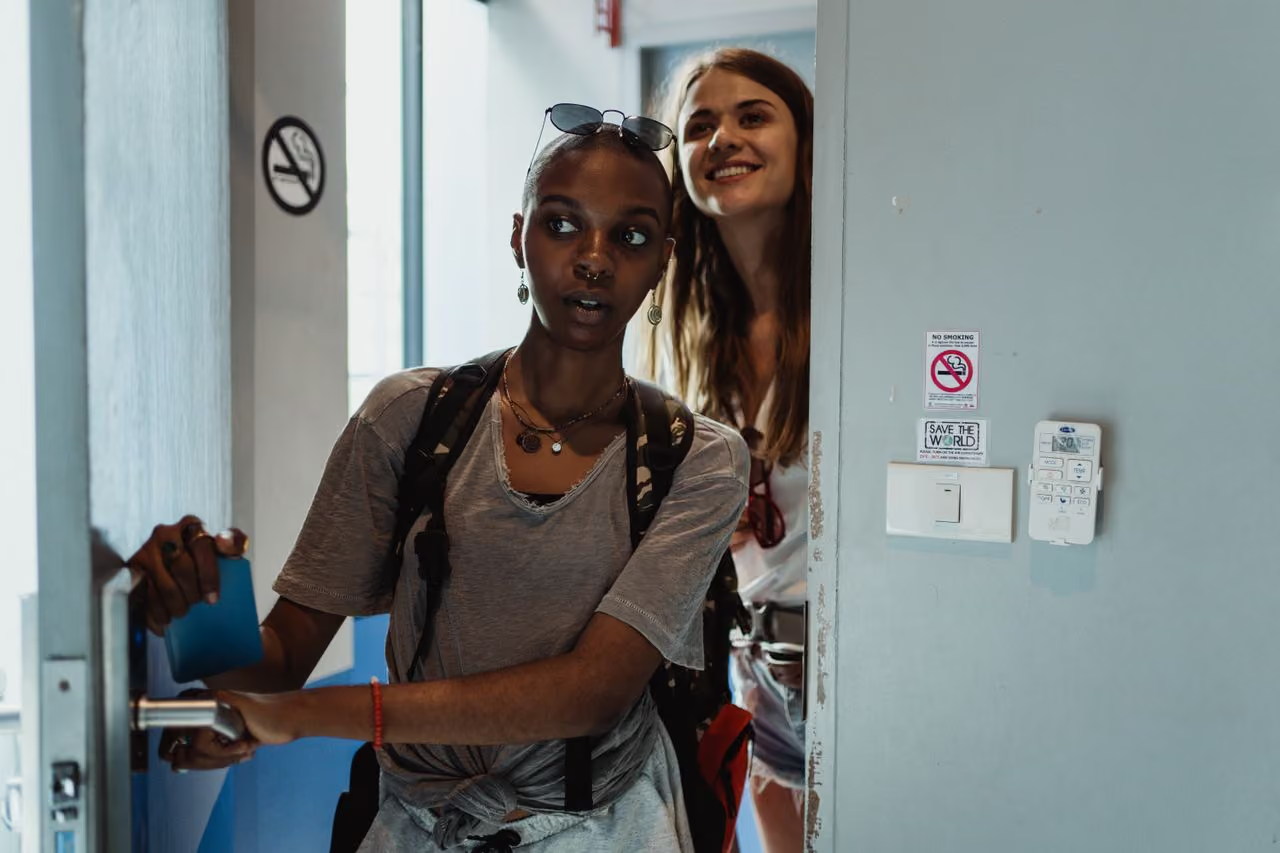
Prop your door open.
It sounds too simple. It works. An open door in a dorm is a universal social signal — I'm here, you can stop by, welcome. It costs you nothing. In the first few weeks especially, when everyone on your floor is looking to connect, an open door generates more organic conversation than almost any deliberate social effort.
That's why a door stopper is one of the must-have items on our dorm room shopping list. It's so simple. It only costs a couple bucks and is easy to overlook, but it opens the door (literally) to a lot of potential frienships.
Eat with people.
Eating alone in the dining hall is fine and sometimes necessary. But if you eat alone by default, you're missing the highest-frequency, lowest-pressure social opportunity in your daily schedule. Ask someone from your floor or a class if they want to grab food. The ask is awkward for approximately five seconds and then it isn't.
Show up to the same things more than once.
The mistake most people make is going to one club meeting, one floor event, one dining hall dinner, and evaluating whether it's worth continuing based on that single experience. Friendships are built on repetition. The second time you show up somewhere, you already know a face. The third time, you already have something to reference. Consistency is the mechanism.
Say yes more than you want to.
Especially in the first month. You'll be tired, you'll want to stay in, you'll tell yourself you'll socialize tomorrow. Go anyway. The events that feel mandatory and low-stakes — floor movie nights, orientation week activities, study sessions in the common room — are exactly where early friendships form. They're not glamorous. They work.
Find your third place.
Your dorm room is where you sleep. Your classroom is where you study. A third place — a coffee shop, a campus green, a library floor, a gym — where you show up regularly and start recognizing the same people, is where a surprising number of organic connections happen. Pick one and make it yours.
How to Figure Out Which People Are Worth Investing In -- And How Much You're Able to Give
Casting a wide net in the first few weeks is correct. You can't know who your people are before you've met them, so you talk to everyone, say yes to most things, and let time do the sorting.
But at some point — usually around week four or five — you start to get a read on who you actually like spending time with versus who you're just around. This is when it's worth starting to invest more deliberately.
A useful filter: after you spend time with someone, do you feel more energized or more depleted? This isn't about whether they're a good person or whether the conversation was technically fine. It's about whether being around them leaves you with more or less capacity for the rest of your day. The people who leave you with more are worth investing more time in. The ones who consistently leave you depleted are not required friendships, regardless of proximity.
Invest in the people you're genuinely curious about — whose lives and interests and perspectives make you want to ask more questions. Those are the relationships that tend to compound. The people you end up eating with out of convenience and habit alone are useful social infrastructure but probably not your people.
The people you meet through shared interest — a club, a class you both chose, a cause, an activity — tend to form faster and stick longer than the people you meet purely through proximity. Proximity gets you in the same room. Shared interest gives you something to build on.
Relationships Will Surprise You.
The friends you make freshman year probably won't be your closest friends by senior year. Some will be. Many won't. The connections that feel most intense in October of freshman year sometimes don't survive sophomore year roommate assignments and changed schedules. This doesn't mean they weren't real or weren't worth having.
The relationships that end up mattering most are often the ones you didn't see coming. The person from your history discussion section who you started studying with and ended up knowing for twenty years. The RA who connected you with a research opportunity that shaped your whole trajectory. The roommate you didn't click with romantically but whose friend group introduced you to the person you did.
College friendship is porous and interconnected in a way that adult social life usually isn't. Relationships lead to other relationships in a way that becomes harder to replicate once everyone is in fixed careers and established lives. A connection you make now has more degrees of freedom — more places it can go — than almost any connection you'll make later.
That's worth something. Even the awkward ones. Even the ones that don't last.
Still struggling after the first month?
Most of the social anxiety of freshman year resolves by October. The chaos of orientation has settled, people have found their basic rhythms, and the forced proximity of dorm life has generated enough repetition for connections to form.
If you're past the first month and still feeling genuinely isolated, the most useful thing you can do is join one structured activity — not for the activity itself, but because structured activities generate the repetition that organic social situations sometimes don't. A club that meets weekly, a recreational sports team, a volunteer organization, a study group for a class you care about. Show up every week for a full semester. Let the repetition do the work.
If what you're feeling goes beyond loneliness into something heavier — persistent sadness, difficulty functioning, anxiety that doesn't lift — please use your campus mental health resources. The waitlists are long and the services are imperfect, but starting that process early matters. The fall semester of freshman year is one of the highest-risk windows for first-episode anxiety and depression in young adults, and the resource is there for exactly this.
The awkwardness of freshman year friendship is real and almost universal and temporary. It passes at different speeds for different people — some people find their rhythm in October and some people find it in April and some people find it sophomore year — but it passes.
You are doing something genuinely hard: building a social life from scratch in an unfamiliar place without any of the scaffolding you've always had. The fact that it's hard doesn't mean you're doing it wrong.
Prop the door open. Eat with people. Show up more than once. Let it take as long as it takes. Making friends in college is worth it.