


Picture this: it’s 2022 and you’ve found your people. Your FYP is a steady stream of candlelit libraries, tweed blazers, rain-soaked cobblestones, and the kind of moody academia that makes you want to read Donna Tartt and drink black tea and feel deeply. You buy the cardigan. You rearrange your bookshelf. You start annotating in pencil. For a while, it feels like more than an aesthetic -- it feels like a version of yourself you’ve been waiting to meet.
Then something shifts. The content is still coming -- more than ever, actually. But something about it starts to feel like homework. You scroll past a “dark academia autumn haul” and feel nothing. Or worse, you feel vaguely irritated. The cardigan is still there but you haven’t touched it. You start to wonder if the whole thing was ever really you, or if you just got swept up in something. Something that has gotten swept away again so very quickly, sometimes even before your long-awaited Cider order can hit your doorstep.
That feeling has a name. It’s aesthetic burnout, and despite what the the tireless forward momentum of the internet would have you believe -- more people feel it than you might think.
It’s Not Just You — Aesthetic Burnout Is a Real (and Named) Phenomenon
“Aesthetic burnout” as a phrase has been circulating in style and wellness spaces for a few years, but it’s gained significant traction in the last two. The pattern is consistent enough that it’s been written about in fashion media, discussed in psychology-adjacent spaces, and — perhaps most tellingly — generates a substantial volume of “is this just me?” posts on Reddit and TikTok from people describing the exact same experience: deep investment in an aesthetic, followed by sudden and confusing disengagement, followed by a low-grade guilt about whether they were ever genuine in the first place.
But let me hold your hand when I tell you this: the guilt is misplaced. It's not some absurd shortcoming. What you're feeling really is a kind of burn out, a kind of option fatigue. And understanding why it happens makes it significantly less disorienting when it does.
The Algorithm Is Doing This to You on Purpose
Not maliciously. But structurally.
TikTok’s recommendation engine — and to a lesser extent Instagram’s and YouTube’s — is optimized for engagement, which in practice means novelty. The algorithm learns very quickly what kind of content you respond to and serves you more of it. That feels good at first: you express interest in dark academia content, and suddenly your whole FYP is dark academia content. When you discover an aesthetic and the community that goes with it, it feels almost like they discover you back. Like when you run into that cute so and so one time at the campus coffee shop, and then all of a sudden -- boom! They seem to be everywhere. At the gym, on the shuttle, in the cafeteria when you are. And it starts to feel like more than a coincidence. Is this perhaps meant to be?
The problem is what happens next. The algorithm’s job doesn’t stop at finding what you like — it keeps optimizing, which means it starts surfacing increasingly niche, increasingly specific, increasingly trend-adjacent content within the aesthetic. Dark academia becomes “dark academia fall 2022” becomes “dark academia but make it Y2K” becomes “dark academia Zara haul under $50.” Each iteration is designed to re-engage you when the previous one has become familiar. When the initial jolt of excitement has worn off.
What you experience as losing interest in the aesthetic is often actually a response to this escalation. You were never losing interest in the underlying sensibility — the love of books, candlelight, old buildings, the particular mood of autumn and studying and being a person who cares about ideas. You were losing interest in the algorithm’s version of it, which by its nature had to keep mutating to stay engaging.
The micro-trend cycle accelerates this. In traditional fashion, trends cycled roughly every 18 to 24 months. TikTok’s trend cycle is measured in weeks. “Mob wife aesthetic,” “coastal grandmother,” “quiet luxury,” “bloke-core,” “tomato girl summer” — these aren’t aesthetics in any meaningful sense. They’re content categories with a 6-to-8-week shelf life, optimized for clicks. When they get folded into the same feed as aesthetics you actually care about, the whole thing starts to feel disposable — including the parts that aren’t.
The Difference Between an Aesthetic and a Costume
This is where it gets more personal and more useful.
There’s a meaningful difference between an aesthetic as a sensibility — a set of values, textures, and moods that genuinely resonate with how you want to move through the world — and an aesthetic as a kit to assemble. The former is durable. The latter has an expiration date, because it’s not actually about you.
Cottagecore as a sensibility: you like slow mornings, growing things, handmade objects, the satisfaction of something done carefully. That doesn’t expire.
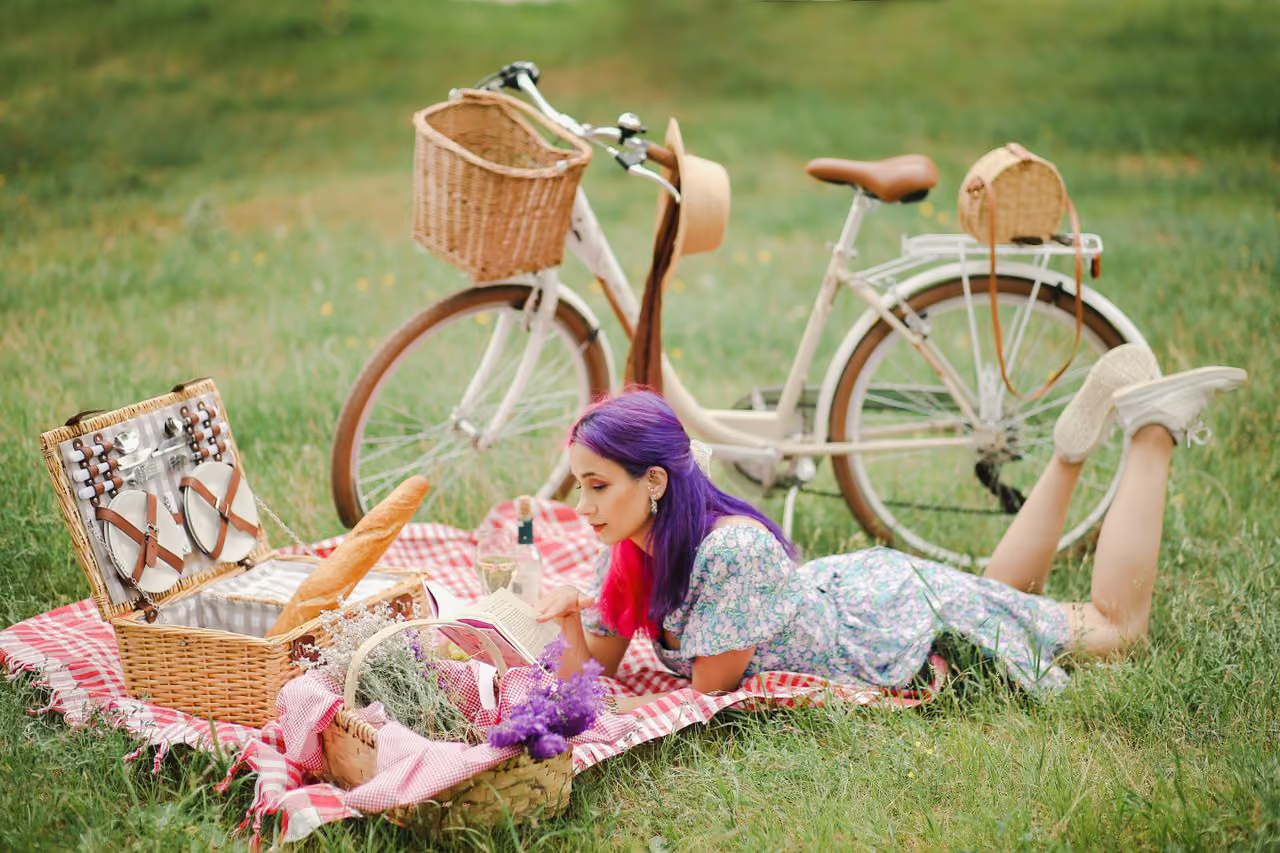
Cottagecore as a TikTok aesthetic: you bought the floral prairie dress and the wicker basket and the dried flower arrangement and now you need the autumn version and the Christmas version and the “dark cottagecore” version. That exhausts itself because it’s a consumption pattern, not an identity.
The burnout often arrives at the seam between these two things — when you started with a genuine sensibility and the algorithm gradually replaced it with its content-optimized version, and at some point you looked up and couldn’t remember which parts were actually you.
The question worth sitting with isn’t “did I ever really like this?” It’s “what did I actually like about it, before it became a feed category?” The answer to that question is probably more durable than the aesthetic itself, and more worth holding onto.
It's similar to the feeling of outgrowing something you thought defined you -- except aesthetic burnout isn’t really outgrowing. It’s more like losing the signal in the noise. The thing you actually loved is usually still there, you just need to know what to look for.

How to Find Your Way Back (Or Forward)
A few things that help — and one that doesn’t.
What doesn’t help: taking a break from the aesthetic content and then returning to the same feed.
If the algorithm produced the burnout, returning to the algorithm returns you to the same loop. The content will be slightly different — a new micro-trend iteration — but the structure is identical. A break followed by re-engagement without changing how you engage just restarts the cycle.
What does help:
Go back to the source material, not the content about the source material. If it was dark academia, read the books — not the booktok about the books. If it was cottagecore, spend time in a garden or a kitchen — not watching videos of someone else doing it aesthetically. The difference between consuming content about a thing and actually doing the thing is larger than it sounds. The former is always mediated, often performing, and optimized for your attention. The latter is just the thing itself.
Separate the sensibility from the trend. Make a short list of the specific things about the aesthetic that you actually loved — not the items you bought or the content you watched, but the underlying qualities. The atmosphere. The textures. The mood. Those are yours to keep regardless of what TikTok does with the trend category.
Wear the cardigan. Or don’t. But stop waiting to feel the way the content made you feel before you engage with the actual things. The content was engineered to produce a feeling. The actual objects and practices are just objects and practices — which is quieter, but also more real and more durable.
Let your aesthetic evolve without it meaning anything. Aesthetic evolution is normal and a reasonable expression of being a person who changes. Dark academia giving way to something softer, or harder, or more personal, or less named — that’s not inauthenticity. That’s just time passing and taste developing. You’re allowed to incorporate what genuinely interests you about a style without performing the whole category.
Get off the feed for a while. Not forever, not dramatically. Just long enough to remember what you actually like when nobody is curating it for you. What you reach for when you’re alone and not performing anything for anyone — including yourself. That’s usually closer to the actual answer than any aesthetic content.
Aesthetic fatigue is real, but you've got this.
The aesthetics themselves aren’t the problem. Dark academia is a genuinely beautiful sensibility. Cottagecore connects people to something slow and handmade and real. Whimsigoth and old money and clean girl and all of it — these categories exist because they’re resonating with something real in the people who find them.
The problem is the pipeline from sensibility to content category to micro-trend to haul to rebrand to next micro-trend, and the way that pipeline moves fast enough to hollow out anything that passes through it.
Aesthetic burnout is the feeling of realizing the thing you loved has been processed into content and you can’t quite find the original signal anymore. It’s not a sign you were fake. It’s a sign you were paying attention.