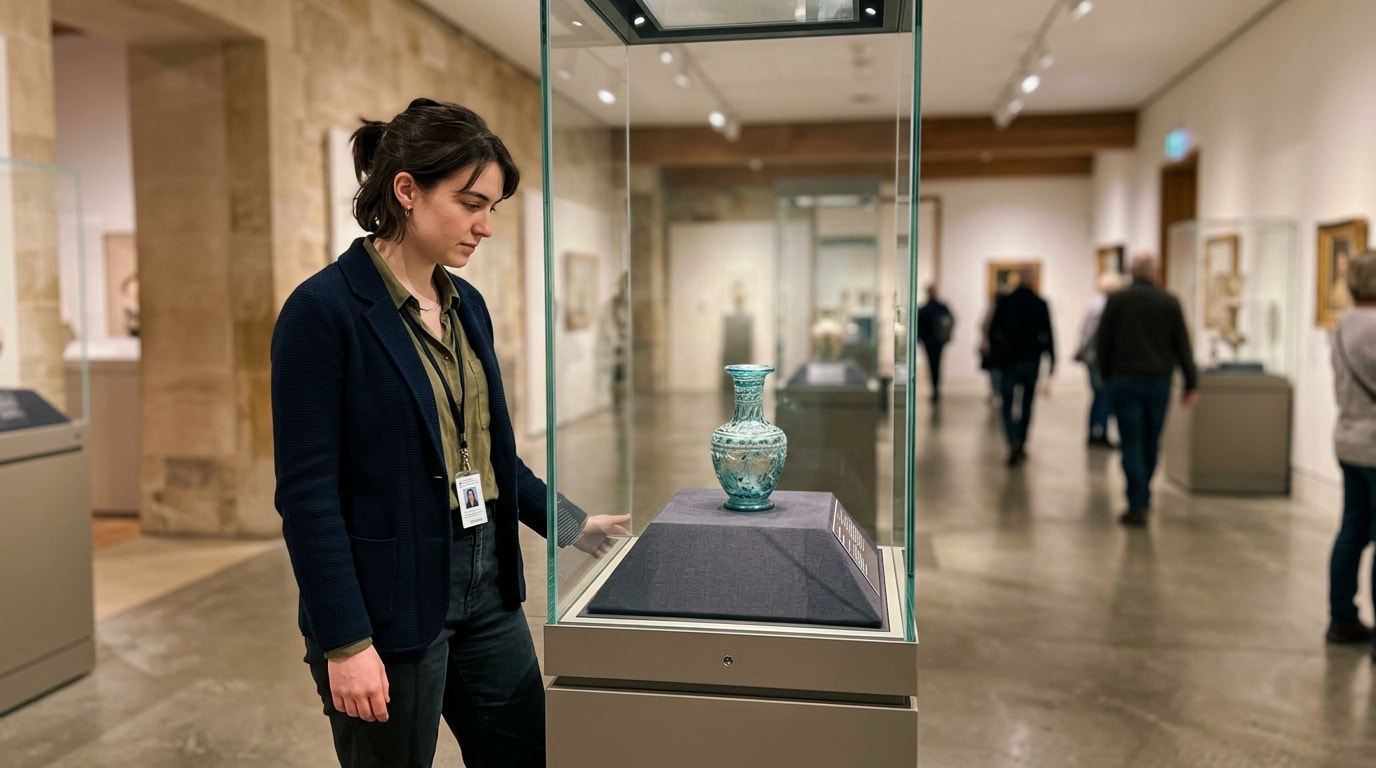


Museum curators are often pictured simply as caretakers of objects, arranging exhibits and managing collections behind the scenes. That description understates how much judgment the role actually requires.
Curators balance preservation, interpretation, and public access as three distinct responsibilities, each demanding a different kind of expertise, and the tension between them is what makes the role genuinely demanding.
None of the three can be handled in isolation without affecting the others, and decisions in one area routinely constrain what is possible in the rest.
In this article, we cover what preservation responsibilities actually involve, what interpretation adds beyond simply preserving an object, how public access complicates both of these responsibilities, and what this balance reveals about curatorial expertise.
💡 The Gist
A curator isn't just someone who arranges pretty things in glass cases. They're juggling three jobs at once: keeping objects from falling apart, deciding what story those objects tell, and letting the public actually see them. Push too hard on any one, and the other two pay for it.
What Preservation Responsibilities Actually Involve
Preservation requires curators to make decisions about how objects are stored, handled, and displayed in ways that protect their physical integrity over long periods of time. Light exposure, humidity, and even the materials used in display cases can accelerate deterioration if not carefully controlled.
This responsibility often involves specialized knowledge of materials science and conservation practices, not simply careful handling. A curator overseeing textiles, for example, needs a different technical grounding than one overseeing metalwork or works on paper, since each material degrades differently under light, moisture, and handling. Understanding decay mechanisms at a technical level allows a curator to set realistic limits on how an object can be used, rather than guessing at safe conditions.
Preservation decisions can directly limit or shape what is possible in terms of display and public access, creating an early point of tension with the curator's other responsibilities. An object too fragile for continuous light exposure may only be displayed on a rotating basis, regardless of its popularity with visitors. In some cases, an object may be deemed unsuitable for physical display entirely, pushing the institution toward digital reproduction as the only viable form of access.

What Interpretation Adds Beyond Simply Preserving an Object
Interpretation involves deciding what context, narrative, and meaning to present alongside an object, shaping how the public understands its significance. Two curators working with the same artifact might frame it very differently depending on which historical thread they choose to emphasize. A single ceramic vessel, for instance, could be presented primarily as an artistic achievement, a trade artifact, or evidence of a specific cultural practice. This requires scholarly judgment about historical, cultural, or artistic context, as well as decisions about which stories to foreground and which to leave out.
🏺 One Object, Three Possible Stories
Take a single ceramic vessel. Depending on the curator's framing, visitors might walk away seeing it as:
- 🎨 An artistic achievement worth admiring for its craft
- 🚢 A trade artifact that traveled between cultures
- 🕯️ Evidence of a specific cultural practice
Same object. Very different takeaway. That choice is interpretation.
Interpretation is inherently subjective in a way preservation is not, requiring curators to justify their choices to scholarly peers and the public alike. A preservation decision can often be defended through measurable data, such as humidity thresholds or material stability, while an interpretive choice rests on judgment that reasonable experts can disagree about.
That subjectivity does not make interpretation less rigorous, but it does mean curators must be prepared to explain and defend the narrative choices they make, particularly when an object's history touches on sensitive or contested cultural ground.
How Public Access Complicates Both of These Responsibilities
Making objects accessible to the public, through display, handling, or digital reproduction, introduces risks to preservation that must be carefully managed. A popular exhibit may draw crowds and generate revenue, but increased traffic and handling can accelerate wear on fragile pieces. Curators must weigh public demand against long-term conservation goals whenever they decide how an object will be shown, sometimes disappointing visitors in the short term to protect an artifact over decades.
Public access also shapes interpretation, since a curator must consider how a general audience, not just specialists, will understand the context being presented. Language and framing that work well in a peer-reviewed publication may need significant simplification for a museum label read in a matter of seconds.
| 🏛️ Responsibility | 🧠 What It Demands | ⚖️ Where It Clashes |
|---|---|---|
| Preservation | Materials science and conservation know-how | Limits how often, and how long, an object can be shown |
| Interpretation | Scholarly judgment about context and meaning | Rests on choices experts can reasonably disagree about |
| Public access | Understanding a general, non-specialist audience | More visitors means more wear, and labels need simpler framing |
Balancing these competing demands means no single responsibility can be maximized without some tradeoff against the others, which is precisely what makes curatorial decisions difficult to standardize across institutions with different collections and audiences.
What This Balance Reveals About the Nature of Curatorial Expertise
Curatorial expertise is not simply subject-matter knowledge, but the judgment required to navigate competing responsibilities that do not have a single correct resolution. The American Alliance of Museums' code of ethics for curators reflects this reality, framing curatorial decisions as ongoing professional judgment rather than fixed procedure.
International Council of Museums standards similarly emphasize that curators must weigh multiple institutional obligations at once, rather than optimizing for any single goal, since collections exist to serve both scholarship and the public.
This kind of expertise develops through experience making these tradeoffs repeatedly, not through formal training alone. The American Institute for Conservation's role in setting conservation practice standards gives curators a technical foundation, but applying those standards under real institutional pressure, budget constraints, and public expectation is a skill built over years of practice.
Recognizing this complexity helps explain why curatorial work commands the scholarly and professional respect it does, even when the public-facing role looks deceptively simple to visitors passing through a gallery.
✅ What Curatorial Judgment Really Looks Like
- 🧪 Using technical data to set real limits, not guesses
- 📖 Choosing a story and being ready to defend it
- 👥 Translating scholarship for someone reading a label in 10 seconds
- 🔄 Making tradeoffs over and over, because there's rarely one right answer
Conclusion
Curators balance preservation, interpretation, and public access as three genuinely distinct responsibilities, and the skill of the role lies in managing the tension between them. Each decision, from how an object is stored to how its story is told, involves tradeoffs that rarely have an obvious answer.
Understanding this balance offers a clearer picture of what curatorial expertise actually requires, beyond the simplified image of someone who simply manages a collection. It is a role built on ongoing, informed judgment rather than a fixed set of procedures.